


The proposed diet, but the paupers never got it all per day.
Wee Hannah Herrity, whose story was told through strange but effective paper mache figures.
The workhouse matron and master.
The proposed diet, but the paupers never got it all per day.
Wee Hannah Herrity, whose story was told through strange but effective paper mache figures.
The workhouse matron and master.

Happening right now, eating gooseberry jam. Edie, that is guuuuuuuuzzberry to you. Smiling.

The Burren is a very odd and special area of Ireland. This limestone plateau was once covered in trees and a very thin layer of topsoil. Early man actually helped to create this 'lunar landscape' through deforestation and subsequent soil erosion.
At first glance there is nothing there but rock. However, it,s home to over 700 species of plants, including 70 types of orchids and 200 kinds of ferns.
Bunbeg was at the half way point of a Donegal loop drive.
We did the second half of the loop yesterday, and before arriving in Northern Ireland, we visited the site of an 1846 workhouse, which opened during the second year of the famine. Being destitute and poor was just about the same as being a criminal. People who just couldn't take it any longer, were admitted on a certain day of the week, appeared before a committee of governors to prove they had nothing, and that they were willing to give up everything.
If they were admitted, they were stripped, deloused and washed, their clothes the same- only taken from them and held until they left again, and were then seen by a doctor to see if they were fit for work. Then they received a special suit of workhouse clothing.
They were required to work, but could not compete with local trades and businesses. In the case of this workhouse, the men broke stones 12 hours a day, and built roads, and modernized the local harbors. The women cooked, cleaned and made clothing, bedclothes, furnishings, and anything else they needed in the house.
The people were separated by sex and age. Even babies were taken away from their mothers. Everything was designed to put you off of wanting to be there, the worst place you'd ever want to be in.
Regulations stated you would get a certain amount of 'wholesome' food, i.e. buttermilk, oats, potatoes, one of the photos has the list, but you rarely got the quantity that was stated.
The story of Wee Hannah Herrity was a real life story that illustrated how someone might come to be in a workhouse. Hannah's mother died in childbirth. Her father was a traveling tailor who remarried, but the step mother didn't like Hannah or her siblings. While her father was away, Hannah was beaten mercilessly and constantly with a switch, the stepmother doing everything she could to kill her.
When the father came home and saw this, he got Hannah a job as a milkmaid at a local farmers. She was only 10 years old, and the farmer said she couldn't stand up to his nasty cow, but she did. Her next 10 years was a succession of farm jobs. She got ill and the farmer refused to help her or pay her, so when she got better, she refused to work for him again.
She became ill again, the doctor was 42 miles away. She walked 84 miles three times in one year, and the doctor really didn't help her. In the end, she was left with no alternative but to go to the workhouse.
She was put to washing clothes. She was resting on the side of the basin in order to keep from falling down when the doctor saw her. He examined her, told her that she was not to work again until she was recovered. He gave her a tonic, and told her to come back when it was gone. She rested all summer recovering her health. She said if not for this doctor, she felt she would have been dead within a week.
As soon as she was well enough, she left the workhouse, became a tinker for while, and did other jobs for the next 70 years, but eventually she was too old to work, and became a beggar. One woman in her town became her friend and benefactor. She got together the people in the town and they built her a one room cottage. There was a large party and they all brought her gifts, so she had everything she needed for herself. It was her first home.
About a year later she died, in 1926, at the age of 90. She and her friend were both buried head to head in the nearby paupers cemetery.
One of the photos is a reproduction of a paupers coffin. The coffin could hold up to 8 bodies, was placed on a horse drawn wagon, and taken to the paupers cemetery. One end slid open as the coffin was tilted and the bodies slid into mass graves.
The Irish famine is considered to be just as bad as the famine in Somalia today.


You'll remember we were looking for Martin's ancestral graves while in Westport. The first time out, we were sent to the wrong cemetery, but Tyler found a surprise for me over the back wall. Pigs! I love pigs.


We didn't have far to drive yesterday, so I decided to paint in the morning.
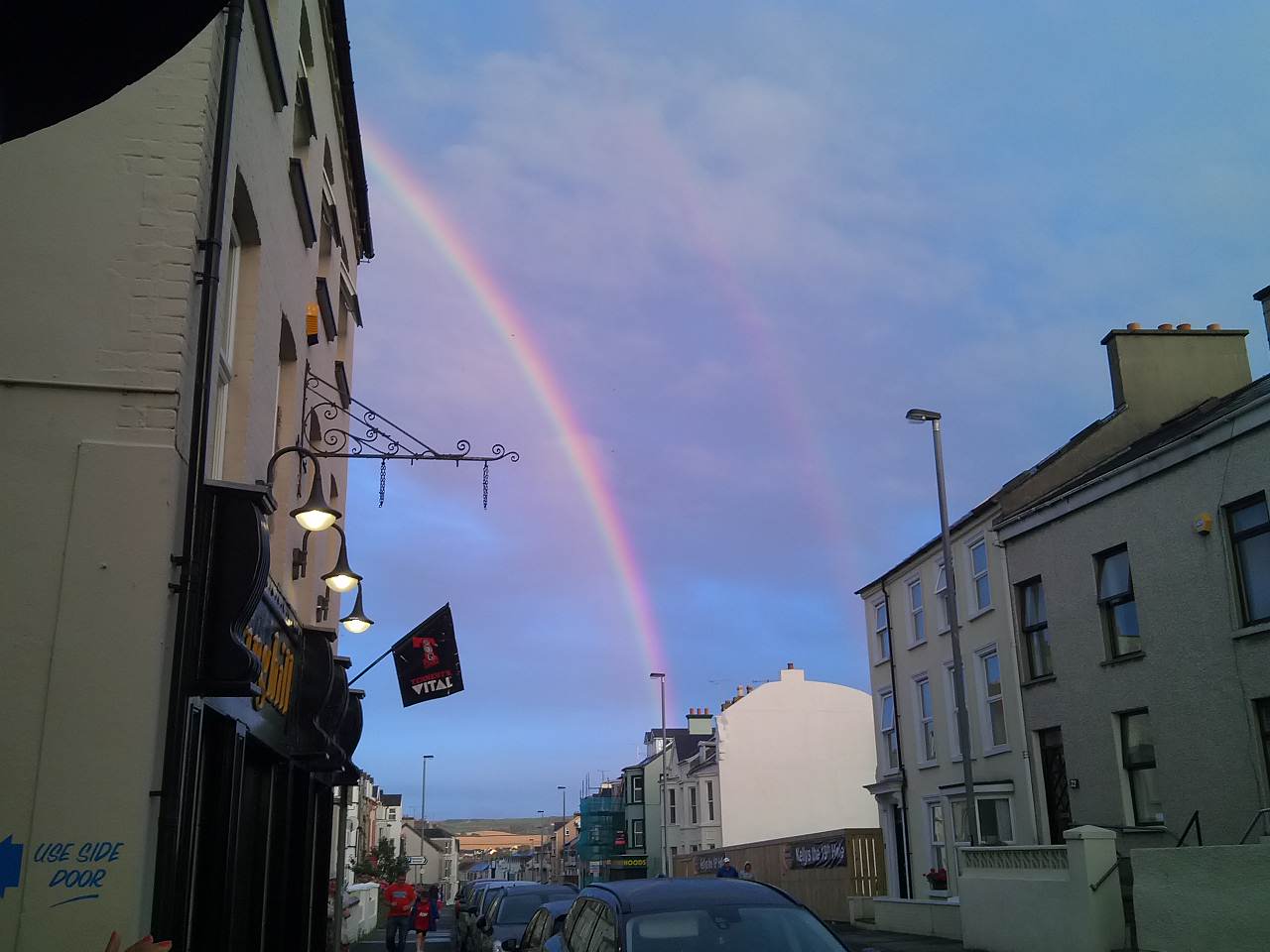

Portrush rainbows greeted us last evening.
Portrush is the premiere resort town on the Antrim Coast. It is crowded with cars and people. I think the best of it could be the view of it, itself. I couldn't get photos of it last night.
Today, we are scheduled to see The Giant's Causeway, and two other things before moving on to Bangor.

We crossed over into North Ireland about 1-1/2 hrs ago. Here is the 2006 Peace Bridge. Derry was the sight of some of the worst fighting, for 38 years. We just whizzed on by it, and are stopping one night in Portrush, on the north coast of Ireland.


We left the Dingle Peninsula on Saturday, August 11. I told you I was behind in my writing, and I am so anal about chronological order. Arrrg.
Before we got to the Cliffs, we stopped by a holy well. Most holy wells are ancient pagan sites. This shrine was chocked full of statues and letters, rosaries and more. Prayers for the dead and dying.


We went through the pass as we left the Dingle. It was windy and cold! But the views were wonderful.


This is the most you will see at the actual site of Ceide Fields, the largest Neolitic settlement in the world from 5,000 years ago. The visitors center is excellent, and helps you realize the area, flora and fauna, and the development of a blanket bog. And they show a film with wonderful aerial views of this site and others, some of which we've visited.
We walked with a guide around 1% of the actual site, just 5 acres, in the wind and driving rain, but the site goes on for miles and miles. What we saw were three piles of rocks, one of which they feel was an animal pen. And the guide showed us the probing technique used to locate the ancient rock walls beneath the bog.
80% of the blanket bog is water, 1% is living plants, and 19% is decaying plants, the peat. It takes one year to make one millimeter of peat = 1,000 years per meter (3.3 ft.), some of it over 5 meters thick.
They have found ancient cereals coming from around Syria, Iraq and Iran. Some pottery shards consistent with that found throughout northern Europe, showing that it took only a couple of thousand years to get to this part of the world.
No fortifications, and single family farms show that these people lived peaceful lives.


We left Westport yesterday morning heading for Ceide Fields in the wild north of Co. Mayo. On the drive out, I finally saw Achille Island. Huge!
Along the drive we saw a really old thatched building. So small and cute, with a peg and wire system to hold the roof in place.
We stopped to go to toilet, and I had fun taking photos, before getting back on the road, and interrupted these colorful sheep trying to have a quiet breakfast.


We are installed in the Donegal Manor, a hotel and cookery school. We had a room with three double beds and a large bathroom. €120 for we four, including breakfast.
Kippers for breakfast this morning!
And Tyler's travelling lunch sandwich from yesterday's drive.


Arrived here in Donegal around 5pm yesterday, had naps and baths, an Indian meal, and the rest stays in Donegal.


Martin pointing out the ancient marks on the stone.
And, the newly weds with one of the most distinctive features in the churchyard, a huge stone cross, most of it buried beneath the ground.


Married again!
Here we are again at Kilmalkadar Church, one of the most important early Christian churches on the Dingle Peninsula. I believe this was on August 10th. I should know as this was my third time marrying Martin, and our second wedding in this churchyard by way of an old ogham stone with a hole at the top. If you wanted to make a contract with someone, or marry someone, you'd come here and swear on the bones of your ancestors, touching your thumbs through the hole.


Dingle Peninsula
1. At the entrance to some beehive huts.
2. Tyler and Granddad laying on top of a beehive hut.
3. An ogham stone in 6th c. monestery. I loved this stone and its carvings. The Christians didn't destroy the ancient stones, the just appropriated what was there and put their own marking, i.e., Celtic crosses and letters on the stones.
4. Tyler inside a lime kiln at the monastic site.
Tyler loves these stone sites. Most of them tell you not to climb on the walls, but no one listens. Here, however, he was trying to warn his Mother of loose stones, and all of a sudden we heard the noise of falling stone. Part of the wall collapsed and he slid down with it. The ONLY reason we didn't feel totally upset was that the walls were reconstructed, about two feet tall.

 Posts
All Comments
Posts
All Comments


